
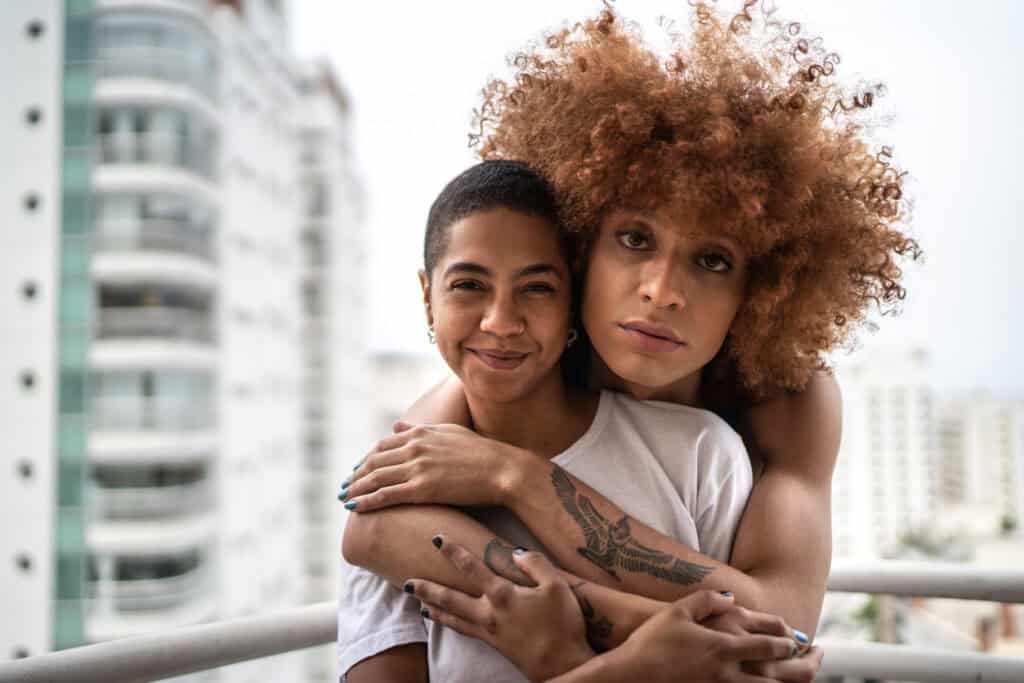
Two brown-skinned queer people face the camera. The one in the back has a big copper-colored afro and wraps their arms around the person in the front. The person in the front smiles
“You’re not born necessarily into a queer family, you have to find it.”
I am only in my mid-20s and have lived at over ten different addresses. I’ve moved for many reasons: schooling, jobs, and love, but underlying each of those moves was actually a desperate search for community.
“Home” for me is a blip on the map just south of Houston, Texas. Growing up, sometimes I felt more at home in the city with the rest of my family and where I could blend into a crowd of people who looked like me, but my mother insisted on the “safety” of small-town life. So, instead, I was big, Black, queer, and poor in a space that revered everything but. Eventually, I left and looked for people who lived out loud.
For college, I ended up in Western Massachusetts. It was only different from my hometown when it came to the foliage and political representatives. There, I ran into primarily white people who didn’t hide their gender expressions or sexualities. I spent my time trying to fit into their friend groups. I was convinced their queerness was the most legitimate because it was the most prominent. The queer and trans people of color I knew were still mostly closeted, often hanging out with me in secret, and it scared me to go back to such a life.
After undergrad, I became engaged to an abuser, a white trans man, in my first openly-queer relationship. We had been together throughout college and were drawn together by our rejecting families. I was convinced that time equaled value, so I clung to the strongest connection I had despite toxicity outweighing the joy. We moved again and again to follow jobs and the promise of opportunity. I noted increasingly frequent displays of white fragility, controlling behavior, and threats to my safety. The facade could no longer be maintained and I finally broke off the engagement. Then, in the middle of a global pandemic, I was alone again.
For the last few years, I’ve taken advantage of worldwide social upheaval (including working remotely and vacated cities) and moved around even more. All the while, I’ve been searching for a place that feels more like home than the last. I’ve been telling myself that somewhere else will be better (and safer) than where I’ve already been, or that I’ll stumble into a niche community that accepts me with little effort. It seems to come easy to other people, so why not me?
Along the way, I began building my world the best way I knew how: through the art of writing. I joined writing courses, weekly groups, and even attempted an MFA in Creative Writing. There, I founded a literary magazine that platformed marginalized writers and received note after note telling me how important it was for it to exist. It got me thinking: my story is not uncommon.
How have other Black queer and trans people found each other?
*
Simone Person (they/them) is a Black queer femme born and raised in the Midwest. Their queer community has been primarily shaped by the internet.
“At my core, I’m an introvert. Living with PTSD has made in-person activities harder, so I really appreciate the resurgence of digital communication,” Person said.
It took Simone years to acknowledge their queerness and transness. Also inundated with white queerness at the onset of self-discovery, they’ve come to believe that community sets Black queerness apart.
“Black queerness has always felt like it’s built on a belief in the future, particularly a future where Black people exist,” Person said. “In contrast, white queerness traditionally has such a deeply embedded sense of hyper-individuality—real ‘I got mine, you should figure out how to get yours’—a complete lack of structural analysis, and is often extremely reactionary (as seen with the rise of trans-exclusionary and sex work-exclusionary politics in so-called radical queer spaces, because whiteness is the same way). Few white people are willing to give up the social power of whiteness, so they continue to repeat the larger structures of oppression.”
*
Adrienne Doyle (she/they) grew up in close proximity to queerness with a bisexual grandmother. This allowed them the freedom to explore their sexuality in more depth, having had a role model throughout their youth. However, their process of finding queer community didn’t take place until around a decade ago.
After developing a crush on a Black queer roommate, the two became great friends. They introduced Doyle to dance parties, cafes, and other queer institutions run by people of color. Soon, jobs and career goals led Doyle into creating their own queer art-centered space.
“It was a response to the white supremacy that exists within Minneapolis’ cultural institutions—the lack of control Black, Indigenous, and POC folks have over their work, the shuck and jive we are asked to do, and the willingness of white folks to fund and consume depictions of our suffering.”
In 2014, Doyle started a two-year project called Burn Something Zine, featuring written and visual work from femme, nonbinary, and trans folks of color in the Twin Cities. The relationships crafted through this zine project informed the co-founding of Burn Something Collective, a group of seven artists working to create opportunities through exhibition and publication projects.
“Social media has felt like the clearest way to stay in contact with people or to just see what folks are sharing about their lives, but the tech bros have designed these platforms to be such energy drains,” Doyle said. “I have been leaning on the people in Burn Something Collective as my tethers to some kind of social life. We were all dissatisfied with what the predominantly white Twin Cities art scene has had to offer our communities.”
Even as they’ve all navigated “disorienting” life changes and loss, some strong bonds have been able to form and even “otherworldly shit that feels like spirit working deep.”
“I envision growing deeper into ourselves as people through these relationships, and growing weirder or more comfortable with making fulfilling choices for ourselves that don’t need to make sense to other people,” Doyle said.
*
Kenia Hale (she/her), a recent Yale graduate, has also lived in multiple cities and crafted new worlds in each. She has organized in Ohio, finished up her senior year in Connecticut, and now, since being in New Jersey, has created an arts collective and started an all-BIPOC rock band. The pandemic, as well as the natural shifts that come with life’s cycles, separated those she knew and severed some ties entirely, making the need for community critical.
“During the summer of 2020, I was wondering ‘how can I find people that understand this deep pain that I’m feeling right now?’”
So, though her recent connections have been more in-person, she knew to turn to the internet when the question reared its head. Before her college and organizing years, Hale had found queer community online. Tumblr and its fandom culture helped put a name to her sexuality.
Perhaps inspired by the stress of rapid change, like her recent loss of a Black queer mentor, Hale believes it’s worth making an attempt to rebuild those online communities.
“When we travel from one place to another and hold tight to those connections, we create a mosaic. It’s a cultural exchange and it allows us to honor the paths laid out by those who came before.”
*
For better or for worse, the internet is the crux of the Black queer and trans community. This proves to be worrisome in a time where net neutrality is frequently at risk and broadband access is limited for those of us in rural and poorer communities. I’ve spent much of my life traveling from place to place, seeking the space with the “most welcoming” QTPOC for making deeper connections, when it seems like saving numbers and socials to a device in my pocket can be equally as effective.
For now, we seem to do this until we can achieve the dream of gathering our branching communities into one place to be near each other more often than not.
“Although we were only able to break bread once before the pandemic began in the U.S., we’ve built tender connections with each other throughout the pandemic and the Minneapolis Uprising,” Doyle said. “This summer, we are finishing up our fourth project together, and then I hope to organize a beach house retreat so we can hang in person for a few days, rest, and vision for the future of our collective.”
Person feels similarly about the relationships they’ve crafted but has been unable to nurture in a face-to-face context. They’re also ready to shift with the tide, since our friendships seem so malleable, especially during a time when the community is not and may never be entirely local.
“My dream is to move to the Colorado mountains and have a Black feminist commune with my homies, but if I have to be more realistic, I just want to continue growing individually and together, even if it means growing apart,” Person said. “I’m trying to accept that change happens, and it’s not always the worst thing.”
For Hale, this perpetual song-and-dance is simply a part of our culture.“You’re not born necessarily into a queer family, you have to find it,” Hale said. “In that same way, you have to find your own heritage and your own place in that legacy.”
Danielle Monique (she/they) is a Black queer nonbinary woman who writes short stories, screenplays, and essays primarily about the effects of marginalization and finding community. Originally from South Texas, their “cities I’ve called home” count is now at ten, including Baltimore, Los Angeles, and New Orleans. When not writing, she can be found communing with the ancestors, playing video games that go easy on the heart, or taking sass from her dog.