
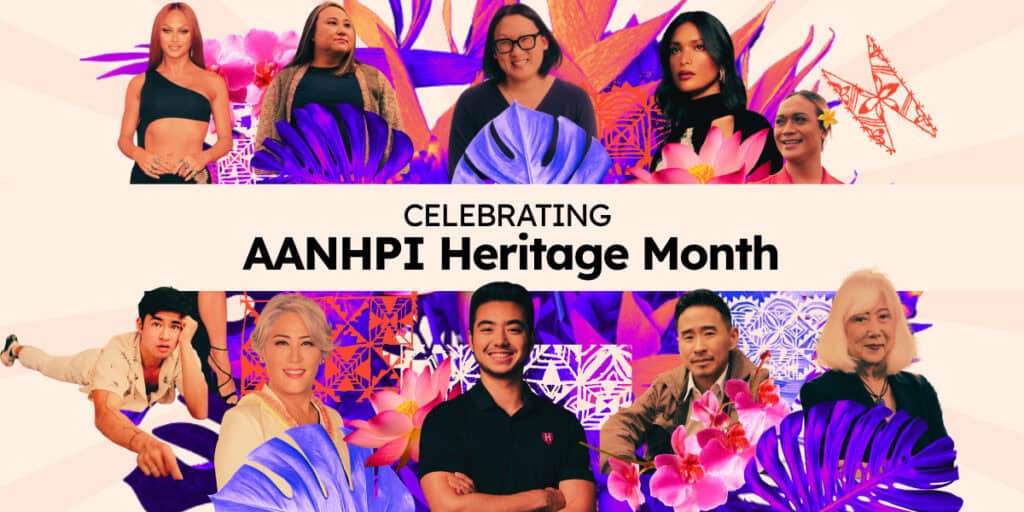
Whether in the courtroom, on the field, or in the capitol, no space is off-limits. These transgender Asian American, Native Hawaiian, and Pacific Islanders prove it.
There is no greater myth than that of trans people being new to public life, visibility, and leadership. Trans people have been here. We’ve existed for eons before this moment, and in most cases, we were revered as healers, spiritual guides, and traversers of two worlds.
For Asian American, Native Hawaiian, and Pacific Islander (AANHPI) Appreciation Month, we’re celebrating eight trailblazers who have made their mark on American history. For decades, trans AANHPI people have been winning cases in courtrooms, passing legislation, breaking athletic records, building nonprofits, and demanding that every facet of American life makes room for their communities.
No space is off-limits. This is trans AANHPI history.
Mia Yamamoto: The Lawyer Extraordinaire
Mia Yamamoto says she was “born doing time.” The daughter of a Japanese American family interned during World War II, she came into this world in 1943 at the Poston War Relocation Center in Arizona. Her father, an ACLU lawyer and the first Asian American to graduate from Loyola Law School, walked around the internment camp telling people the government ‘couldn’t just lock people up because of their race.’ His courage and unwavering belief in the Constitution became the blueprint for Mia’s own legendary career as a criminal defense attorney and civil rights activist.
After earning her law degree from UCLA (where she co-founded the Asian Pacific Islander Law Student Association), serving in Vietnam, and spending years as a public defender on over 200 jury trials, Mia made another kind of history. In 2003, on her 60th birthday, she came out as transgender and became the first openly trans trial lawyer in the state of California.
“I realized I might die as a coward and a phony — two things I hate in people,” she said to AARP in 2022.
When she stepped into her truth, she didn’t lose clients, and she certainly didn’t stop fighting. Mia expanded her advocacy to include trans communities, LGBTQ+ people of color, and those pushed to the edges of the justice system. She has been honored with the Liberty Award from Lambda Legal, the Harvey Milk Legacy Award from LA Pride, and received recognition from API Equality. But the most resonant tribute is her own words, offered to every trans person who comes after her:
“Every trans person should aspire to everything. Be the greatest lead singer in a band, be the best politician, be the greatest lawyer you can be. All those things are going to be available because people fought for us, people advocated for us, people opened doors and made space for us. And you’re gonna have to return that favor and pay it forward for the next generation. Nothing good happens without all of us doing it together.”
Schuyler Bailar: The Swimming Sensation
Schuyler Bailar loved swimming before he could walk. At age seven, he swam in his first meet. At age 10, he qualified for the Junior Olympics. And just three years later, barely a teenager, he began competing at the national level. As a high school swimmer, he was recruited to swim for Harvard University.
Then came the not-so-glamorous parts: an eating disorder, depression, a months-long stint in treatment during a gap year, and the most important realization, emerging slowly and then all at once, that he was trans. Harvard had recruited him for the women’s team, and his transition raised questions about the future of his swimming career.
The answer was simple: Bailar would swim for Harvard’s men’s team. In 2015, he became the first openly transgender NCAA Division I swimmer and the first trans man to compete on a men’s Division I team in any sport. His breaststroke times ultimately ranked in the top 15% of all NCAA men’s swims for the season. He won three Ivy League Championship rings. In 2019, he graduated to a standing ovation for the sport he had given everything to.
Since then, Bailar has become one of the most prominent trans athlete advocates in the country, hosting a podcast, running educational programs for corporations and schools through his LaneChanger series, and showing up consistently wherever trans youth need someone to say: This is possible. “I really just want to be visible so people know this is possible,” he said to NBC News in 2017. He is proof that a trans athlete, a half-Korean athlete, a whole person can exist and thrive.
In March 2026, Bailar competed in a triathlon relay at the Ironman 70.3 in Oceanside, California alongside fellow trans athletes Cal Calamia and Chella Man. Their team was the first all trans team to compete in any Ironman and placed third in the men’s division, beating 80 other teams of cisgender men.
Kim Coco Iwamoto: The Political Powerhouse
In November 2006, Kim Coco Iwamoto won a seat on the Hawaii Board of Education. It was a statewide election, and she won it as an openly transgender woman — making her, at that time, the highest-ranking openly transgender elected official in the entire United States.
She was re-elected in 2010 with 25% more votes than she received in her first race. She served on the Hawaii Civil Rights Commission and ran for Lieutenant Governor. In 2024, she won a seat in the Hawaii House of Representatives, defeating the sitting House Speaker in the Democratic primary. The arc of her career as an elected official now spans nearly two decades.
Before politics, she volunteered at community centers in New York City helping LGBTQ+ homeless youth. She became a licensed therapeutic foster parent. She worked as a managing attorney for volunteer legal services. Her political career did not emerge from nowhere — it grew from years of showing up for people the system had abandoned, because she knew what it felt like to be one of them.
Iwamoto’s story is also a deeply AANHPI story: She is a fourth-generation Japanese American whose grandparents labored in the sugar cane fields of Kaua’i, and whose mother’s family was forced into the Poston War Relocation Center during World War II (the same internment camp where Mia Yamamoto was born). Iwamoto represents how AANHPI communities have had to fight for their place in American democracy, and how trans AANHPI people are fighting that battle on multiple fronts simultaneously.
President Barack Obama recognized her as a Champion of Change in 2013. Newsweek named her one of 50 need-to-know pioneers for LGBTQ rights in 2018. Hawaii’s state house now has her vote.
Jaiyah Saelua: The International Athlete
In 2014, American Samoa, a tiny island nation, won their most important soccer (football) game ever. After 38 consecutive losses over 17 years, Samoa was ranked last by FIFA (Fédération Internationale de Football Association). Then, their 2-1 victory over Tonga in the World Cup qualifier made history. And Jaiyah Saelua, the center-back of the American Samoa team who provided a key assist in the game-winning goal, was named Woman of the Match by her coach. She became the first openly nonbinary and trans woman to compete in a FIFA World Cup qualifying match, making history for herself. FIFA President Sepp Blatter sent her a personal letter recognizing her milestone.
Saelua is fa’afafine, a recognized third gender in Samoan culture. “Fa’afafine is such a part of our culture we don’t feel the need to explain it. It’s a coming of age story as opposed to a ‘coming out’ story others in the rainbow community have,” she said on the Humans United FC podcast. Her confidence comes from her heritage — an island community that already knew how to honor people like her, had language and a cultural understanding of her identity, and that celebrated her long before any international governing body did. As a FIFA Ambassador for LGBTQ+ equality, Saelua now carries that sense of home with her to every corner of the world.
Saelua has been named a FIFA Legend, an honor traditionally reserved for players who have won World Cups or amassed hundreds of international caps (a player’s appearance in a game at international level), because of what her representation meant for the global LGBTQ+ movement in sport. The 2014 documentary “Next Goal Wins” told her story. In 2023, Taika Waititi adapted her story into a version for millions more to witness. Yet, Jaiyah Saelua’s true legacy outlasts any Hollywood retelling.
Chella Man: The Multifaceted Artist
Chella Man, a Deaf, transmasculine, genderqueer, Chinese, and Jewish artist, has built one of the most expansive creative careers in contemporary trans art. As the first Deaf transmasculine model signed to IMG Models; the first transmasculine actor cast in a DC superhero series (Jericho in “Titans”); a published author (“Continuum,” Penguin Random House); a visual artist with solo gallery shows; and a YouTuber who documented his transition in videos that have millions of views, Man has claimed space with the same force others claim legislative or athletic space.
His art practice is explicitly about liberation and what it means to exist in a body that the world has consistently tried to define from the outside. He refuses definition at every turn. “I am an artist living as a cyborg,” he said in a statement for his exhibition “It Doesn’t Have To Make Sense”, “committed to sharing the frameworks I’ve designed upon routinely discarding projected assumptions and binary beliefs.” In March 2026, he placed third in the Ironman 70.3 in Oceanside, California alongside his teammates, Cal Calamia and Schuyler Bailar.
Kris Hayashi, Cecilia Chung, and Andrea “Andy” Hong Marra: The Nonprofit Queens
Behind every milestone is a foundational infrastructure. Behind every trans person who walks into a courtroom or a locker room with their rights protected is an organization, legal framework, or coalition that had to be built. For the trans AANHPI community, much of that infrastructure was built by three people: Kris Hayashi, Cecilia Chung, and Andrea “Andy” Hong Marra.
Kris Hayashi spent nearly a decade as Executive Director of the Transgender Law Center, one of the nation’s largest trans-led legal organizations driving litigation, policy advocacy, and movement building on behalf of trans communities. They specifically focus on those most marginalized: trans people of color, immigrants, and incarcerated individuals.
Cecilia Chung, a Chinese American trans activist based in San Francisco, has spent decades working at the intersection of trans rights, HIV/AIDS advocacy, and racial justice. As Senior Director of Strategic Initiatives and Evaluation at the Transgender Law Center, and through her leadership at the Horizons Foundation and other organizations, she has helped build the legal and public health infrastructure that trans communities depend on. She has served seven years on the San Francisco Human Rights Commission and brought her expertise to national and international stages.
Andrea “Andy” Hong Marra has led API Equality-LA, building critical space for AAPI LGBTQ+ people and emphasizing that trans justice cannot be separated from racial justice. Her work ensures that the specific experiences of trans AANHPI people are not collapsed into a generic trans or AAPI narrative, but are seen as whole and unique.
Hayashi, Chung, and Hong Marra do not typically make headlines the way FIFA ambassadors or Ivy League swimmers do. But without the cases filed, the coalitions built, or the policies changed, many of the other milestones in this piece would not have been possible.