
Southern HIV/AIDS Awareness Day 2026: A Complete Resource Guide
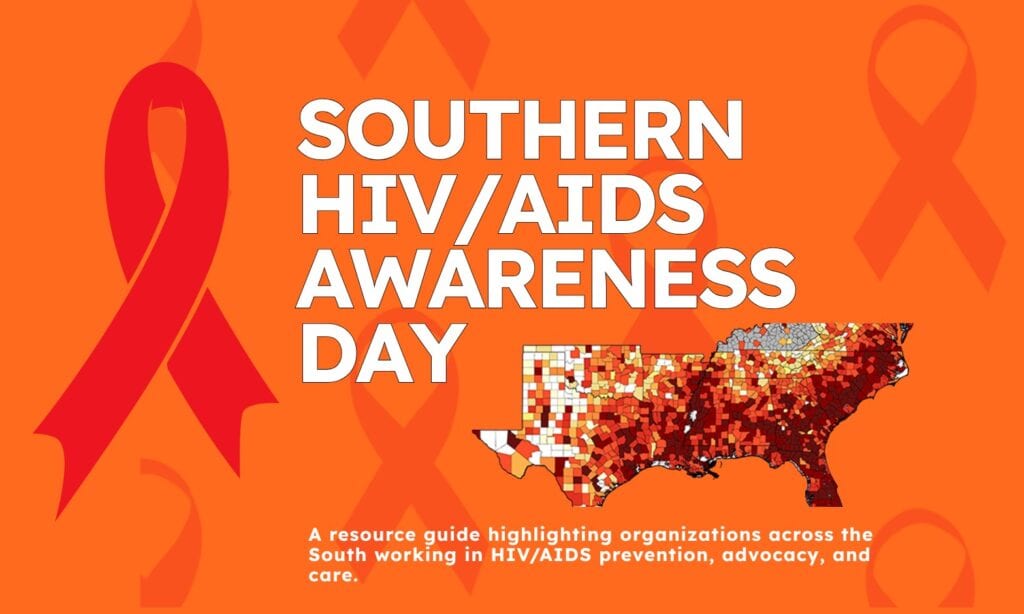
Southern HIV/AIDS Awareness Day Resource Guide header image.
This Southern HIV/AIDS Awareness Day, we are centering the queer and trans advocates who are fighting decades of political neglect to build real, community-led care in the South.
On August 20th communities across the South celebrate Southern HIV/AIDS Awareness Day, known as SHAAD. It is a day built by the South, for the South. The Southern AIDS Coalition founded SHAAD in 2019 to redirect national attention toward an HIV epidemic that the rest of the country had largely stopped paying attention to, despite its ongoing and devastating impact.
This year’s SHAAD theme is S.T.E.P. in Solidarity, short for Southern Trailblazers Empowering Progress. It’s a call to uplift Southern voices and build deeper intersectional collaboration at a moment when the region faces more threats to its public health infrastructure than it has in years.
For queer and trans Southerners, especially Black trans women and Black queer men, HIV has never been an abstract statistic—or an epidemic of the past. It’s a public health crisis shaped by decades of government neglect, lack of investment, stigmatization, and a healthcare system that too often refuses to even recognize those most vulnerable to the virus at all.
This guide centers the trans and queer-led organizations and advocates doing that work first, and the broader Southern HIV/AIDS movement second. Because without the people doing the work, there is no movement.
The South makes up roughly 38% of the U.S. population but in 2024, when the CDC last collected this data, the region accounted for 51% of new HIV diagnoses nationwide—a ratio that has existed for the last decade. Research from Duke University found that in the Deep South, Black residents were diagnosed with HIV at eight times the rate of white residents.
Transgender people remain a small share of new diagnoses nationally, but these numbers are rising. Between 2018 and 2022, diagnoses among transgender women rose by 25%. And over 40% of trans and gender nonconforming people newly diagnosed with HIV in 2022 were Black. A recent national research cohort tracking HIV among trans women found that a third of its participants came from the South.
These statistics are not inevitable, however. They’re the result of continued policy decisions to restrict Medicaid, limit access to comprehensive sex education, and attack trans healthcare instead of funding it. This is why Southern HIV/AIDS Awareness Day exists: to name these factors explicitly and to call for accountability. In other words, to say the quiet part out loud.
This year’s SHAAD comes at a time of intense instability. Throughout 2025 and into 2026, the Trump administration’s budget proposals have sought to eliminate CDC HIV prevention funding entirely and have cut major pieces of the Ryan White HIV/AIDS Program, the country’s core safety net for HIV care. House Republicans even proposed a 20% cut to Ryan White and a full end to federal HIV prevention spending. Ultimately, Congress rejected the deepest of those cuts in its final budget proposal, preserving funding on a bipartisan basis. But the damage had already been done in places like Mississippi, where grant terminations and clawbacks hit community organizations hard. My Brother’s Keeper, a Jackson-based nonprofit, lost more than $1 million in federal grants and had to close clinic locations, including a mobile unit that provided HIV testing. Staff watched years of work disappear within weeks.
Trans and Queer Led Organizations To Know and Support
These organizations are led by the same communities they serve. Supporting them directly is the simplest way to support this year’s S.T.E.P. in Solidarity theme.

The Knights and Orchid Society (TKO) – Selma and Montgomery, Alabama
Founded in 2012 by Quentin Bell, TKO became Alabama’s first Black trans-led AIDS Service Organization. Under current executive director TC Caldwell (they/them), TKO provides HIV and STI testing, gender-affirming primary care, and food, housing, and utility assistance for Black trans, queer, and gender-nonconforming people across rural Alabama.
THRIVE SS – Metro Atlanta, Georgia
Co-founded in 2015 by three Black gay men living with HIV, Dwain Bridges, Daniel Driffin, and Larry Scott-Walker, THRIVE SS built a peer support model that treats belonging as part of the treatment plan. Its programs include support groups, a public speaking group, and THRIVE House, transitional housing for HIV-positive Black gay men and transgender women. (Update: THRIVE SS closed in 2025)
My Sistah’s House – Memphis, Tennessee
Founded in 2016 by Kayla Gore and Ellyahnna C. Wattshall, My Sistah’s House is a Black trans-led organization that grew out of Gore’s own experience with homelessness. It runs emergency housing, the Tiny House Project, and HIV testing and navigation services, primarily for transgender and gender nonconforming people of color.
The Normal Anomaly Initiative – Houston, Texas
Founded by Ian L. Haddock (he/they), this Black queer-led organization runs the Black Queer Plus: Center for Liberation, Houston’s only standalone space for Black LGBTQ+ people. Its work spans HIV testing, employment support, and the Transgender Allyship Collective.

The McKenzie Project – Miami-Dade and Broward Counties, Florida
Founded by Jasmine McKenzie, a Black trans woman and HIV survivor, this is the only Black trans-led organization in Miami-Dade County. It focuses on housing, HIV awareness through creative arts, and helping Black trans women build alternatives to survival sex work.
More Southern HIV Organizations Worth Uplifting
These organizations are not all trans or queer-led, but they’ve shaped the Southern HIV response for decades and remain central to it, including for LGBTQ+ people in the region.
Southern AIDS Coalition — regional, headquartered in Georgia
Founded in 2001 and the organization behind SHAAD itself, SAC leads policy advocacy, capacity building, and grantmaking across the South. It also runs the Saving Ourselves Symposium (SOS), a conference built to educate and empower the Black LGBTQ+ community. New executive director Danielle Houston, who started in early 2026, brings over 15 years of HIV prevention and health equity work in the region.
SisterLove, Inc. — Atlanta, Georgia
Founded in 1989 by Dázon Dixon Diallo, SisterLove is the oldest women-centered HIV and reproductive justice organization in the Southeast. Its work includes free testing, PrEP access, and programs addressing LGBTQ+ health alongside its core reproductive justice mission.
My Brother’s Keeper — Jackson and Ridgeland, Mississippi
Through its Open Arms clinic, MBK has provided HIV and STI testing and outreach for African American communities for over 25 years, work that continues even after 2025’s federal funding cuts forced it to close some locations.
South Carolina HIV/AIDS Council — Columbia, South Carolina
A statewide provider of Ryan White services and HIV prevention programming with dedicated outreach to LGBTQI communities, filling a gap in a state with few Southern HIV organizations of its size.
Advocates Carrying This Work Forward
TC Caldwell (they/them): Executive Director of TKO Society, a Black trans, nonbinary organizer and narrative photographer who also founded CoffeeHouse Poets, a performance-art project rooted in community activism.
Kayla Gore: Co-founder of My Sistah’s House. A Black trans woman who survived homelessness and has since become a national voice on housing as HIV prevention, testifying to how anti-trans legislation directly produces housing instability.
Jasmine McKenzie: Founder of The McKenzie Project. A Black trans woman and HIV survivor from Liberty City, Miami, she built her organization around the belief that her community doesn’t need saving, just resources and dignity.
Ian L. Haddock: Founder and executive director of The Normal Anomaly Initiative in Houston. Haddock built the organization from a personal blog into one of Texas’ leading Black queer-led institutions while working through his own homelessness.
Daniel Driffin: Co-founder of THRIVE SS in Atlanta. In 2016, Driffin became the first HIV-positive speaker at the Democratic National Convention in 16 years, and has spent his career building peer models that treat people living with HIV as experts in their own care.
Deon Haywood: Executive director of Women with a Vision in New Orleans. Over more than 25 years, Haywood has linked HIV prevention to sex workers’ rights and reproductive justice, helping lead the fight that removed hundreds of people from Louisiana’s sex offender registry.
Danielle Houston: The new executive director of Southern AIDS Coalition as of early 2026, stepping into the role after more than 15 years across Gilead Sciences and NMAC, where she launched the National HIV PrEP Summit.
Jasmine McKenzie put it plainly: Her community doesn’t need saving. It needs resources, action, and consistency. That’s true across the South, where queer and trans organizers have built life-saving community organizations with less money and more political hostility than almost anywhere else in the country. SHAAD isn’t a day to look at the South with sadness. It’s a day to look at what’s already been built and ask what’s possible with real support behind it.