
Midway through Trump’s second term, trans advocates take stock
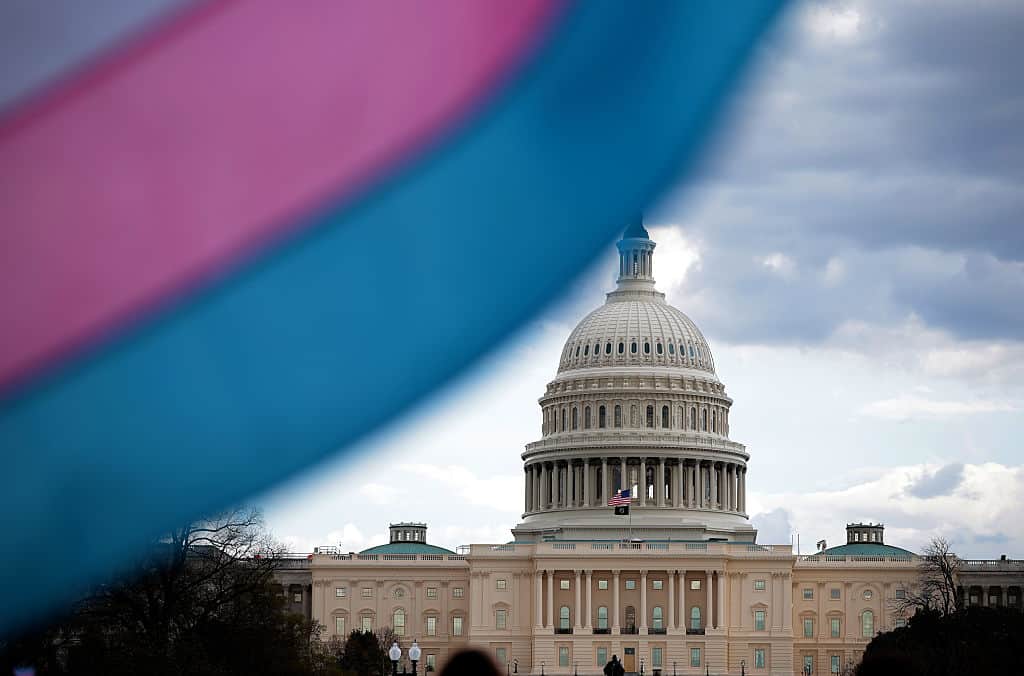
Photo by Kayla Bartkowski/Getty Images
Trans advocates from across the United States share their perspectives on the current state of trans life in America.
At every level of government in the U.S., conservatives are using their power — often successfully — to strip trans people of their legal rights and protections.
While next week’s midterm elections offer reason for hope, even the most experienced advocates and experts say it’s not clear if the worst has happened, is happening, or is yet to come. Large gains for the Democratic party might slow the passing or mitigate the enforcement of ever-harsher measures targeting trans people. However, the diminished role of Congress and the extreme divisions between conservative and liberal states on these issues suggest the road to securing trans rights and protections, even those previously held under U.S. law, will be long.
The TransLash Wire spoke with four experienced trans advocates and journalists from across the country to find out what the state of trans life in America looks like from their point of view.
Challenges for local trans communities differ greatly by state
“There is a lot of holding our breath,” says Angelique Godwin, director of transgender equality for Equality Florida. “We are constantly in a state of ‘What now?’ and ‘What next?’”
According to Godwin, law enforcement in Florida have largely avoided direct conflict with activists. Instead, trans people with the least power to fight for themselves are among those who have lost the most. This includes children in public schools, now treated as members of their birth sex by law, as well as government workers, including teachers, who must submit to anti-trans policies or lose their jobs.
The most headline-grabbing anti-trans policies in Florida, Godwin says, are the ones that have “more bark than bite.” For example, a bathroom ban for state and local government buildings is on the books, but only one person has been arrested under the law — an Illinois trans woman who announced to authorities her intent to violate the law. Her case was subsequently dismissed.
There are more protections in place in Democratic-led states. Still, community advocates across the country tend to speak about their concerns in strikingly similar terms, no matter what state they reside in.
“You’re always waiting for the other shoe to drop. You’re always worrying, ‘What new regulation is going to come out? What new law is going to come into place? Is there going to be another terrible executive order trying to strip us of our rights?’” says Finn Gardiner, the advocacy and organizing manager of the Massachusetts Transgender Political Coalition.
According to Gardiner, the state government in Massachusetts has partnered with advocates to protect trans people where they can. This is true to an extent in most states governed by Democrats. Despite great pressure, the Democratic party has largely maintained their support of equal rights. The successful federal efforts have almost exclusively happened in the executive branch. Efforts made by Republican legislators to follow suit have been repeatedly stopped by Senate Democrats.
Even so, the impacts of President Trump’s executive orders have led to changes in blue states, with clinics ending trans healthcare in Massachusetts, New York, and beyond, particularly for trans youth. Across the country, the right’s culture warring has emboldened extremists. In Massachusetts, this has resulted in repeated bomb threats against health care providers, and, Gardiner says, targeted threats and harassment against trans advocates. GLAAD, the world’s largest LGBTQ media advocacy organization, has attempted to track violent incidents and reported a 14% increase from 2024 to 2025.
Anti-trans measures impact every aspect of trans life
The number and vast scope of federal and state anti-trans measures makes them impossible to catalogue briefly. One widely felt measure is last year’s restrictions on U.S. passports, turning every border crossing into a forced outing.
Trans adults can no longer enter the military, and existing trans service members have been kicked out. Trans youth in supportive families have seen their options for treatment disappear in conservative states and dwindle in liberal states.
Less visibly, the federal government no longer takes action to address discrimination against trans people in the workplace. It also excludes transgender prisoners from rape protection efforts in federal prison. Grantmaking has been revamped, with recent rules requiring anyone who seeks federal funding to endorse anti-trans ideology to be eligible. Information from research on the trans community has been erased from government websites and records. Veterans have lost access to transition-related medical care at the Department of Veterans Affairs.
Conservative states have all gone much further, with a slate of laws seeming to have large portions copied from anti-trans templates. However, subtle differences in language make it difficult for advocates and journalists who seek to keep their local communities informed. State laws target children in public schools, government workers, bathroom use, and identity documents. Some seek to negate anti-discrimination measures at the local level.
“The attacks on the community have been so many, and so in sync, and so similar across the U.S. that it has made it hard for anybody to gain a strong footing in preventing the attacks — let alone helping the community understand exactly what it means for them and their day-to-day life,” says Godwin. Too much is changing too quickly, with state and local governments having too great an impact.
Internal displacement is reshaping where trans Americans live
Trans people’s lives have changed dramatically, and many irrevocably since Trump’s re-election in 2024. One of the most tangible signs is the current wave of internal migration, as trans people in conservative states risk everything to relocate to states where they’re able to live more freely.
Trans refugees are converging on cities and states in search of protection, community, and medical care. In some cases, the influx has begun to overwhelm aid efforts organized by local communities. The Seattle LGBTQ Commission has petitioned Mayor Katie Wilson to declare a state of civil emergency and free up additional funds to support trans-led organizations that have been struggling to meet the needs of the increasing population.
A 2025 report by the Williams Institute found that nearly half of trans people surveyed had relocated or wished to do so. A survey funded by the Movement Advancement Project that same year found that one in 11 trans people had already moved. Numbers continue to fluctuate, but organizers in cities with significant trans protections report seeing the results firsthand.
One such organizer is Aspen Coyle of Seattle, who works with internally displaced trans people at the trans community action non-profit, TRACTION, where she is the program manager of Project Open Arms. On a video call, Coyle told TransLash about a couple of relocation cases TRACTION has been working on. In one case, a person she called “M” reached out after M and her wife, who is also trans, were attacked and beaten on city streets in a conservative state.
Coyle stressed that many trans people attempting to flee are very young. A trans girl she called “S,” who lives with her parents and recently started taking estrogen, anticipates being kicked out of her home once her parents notice that she’s medically transitioning.
“When she is kicked out — and it is a when, not an if — she’s going to come to Seattle,” says Coyle. “She’s going to come to Seattle whether or not there’s any realistic plan, or a way for her to get housing. That’s because if it’s between being homeless in a red state or homeless in Seattle, every trans person is going to pick being homeless in Seattle.”
Media apathy exacerbates issues trans people face
Thousands of trans people fleeing oppressive conservative state governments should be a national story, but internally displaced trans adults have yet to garner mainstream news coverage. This is par for the course during the second Trump administration, according to Tre’vell Anderson, the executive director of the Trans Journalists Association.
“One would think that the news coverage would reflect the dire straits that the community is facing across this entire country,” Anderson says. “Trans people are suffering. Our care has been impacted. Our access to public space has been impacted. And I don’t think you would know that if you looked at mainstream media alone.”
U.S. news organizations have failed to inform Americans about the scope and impact of anti-trans actions by both federal and state governments. There seems to be a sense among cisgender editors and journalists that trans issues are niche and relatively unimportant, despite having been the top policy priority of one of our two major political parties for many years.
However, editorial decision-making is only the tip of the iceberg. The Trump administration’s modus operandi when it comes to the media has long been to “flood the zone with shit,” as former White House chief strategist Steve Bannon bragged to Bloomberg’s Michael Lewis during Trump’s 2018 State of the Union. The strategy is to create such a high number and frequency of destabilizing news stories — often rife with misinformation — that no one can keep up with the media cycle, let alone process the deluge of information. This endless flood of content has led many people to withdraw from keeping up with current events due to mental overwhelm; others have lost trust in the media’s ability to report verifiable facts altogether. In late 2025, Gallup reported that only 28% of Americans have confidence in the mass media to report news fairly and accurately.
Added to this is the fact that media layoffs have shrunk national newsrooms, including the Washington Post, LA Times, NPR, CNN, CBS, NBC, ABC, and many more. Outlets that remain focused on national stories have also been increasingly subject to political interference. Taken together, it’s a perfect storm of conditions that prevent the public from learning about the ongoing assault on trans lives.
Anderson agrees. “It’s because there’s so much happening, because newsrooms are shrinking, because there’s so much overwhelm with a news cycle as quick as it is, the broader public is uninformed about the realities of what is happening and how it is happening.”
The midterms and beyond
The United States is approaching midterm elections in a climate of widespread dissatisfaction with Republicans in general and the president in particular. As anti-trans ads from Republicans once again blanket our screens and airwaves, some Democratic candidates have moved closer to Republicans, in some cases echoing hateful language while promising to continue the right’s anti-trans crusade.
In other races, progressive candidates have portrayed their refusal to compromise on trans rights as emblematic of a fighting spirit that distinguishes them from other politicians. Still, it’s clear that even an overwhelming Democratic victory will only be the beginning of a fight to restore the rights we’ve lost.
Around the country, trans people continue to show up for one another in crucial ways. The trans mutual aid movement is a particularly bright spot, with projects to help internal refugees settle in Seattle, find connections and resources in Cincinnati, access housing in Philadelphia, and many more.
Trans people in every state are also fighting in solidarity alongside cis people for a better country. Trans people are overrepresented among those arrested for opposing brutality and lawlessness by ICE. While part of this is the government’s stated desire to target the trans community in service of a false narrative that advocating for trans rights is akin to terrorism, the other reason is that the trans community has been deeply involved in ongoing efforts to preserve human rights and individual freedoms everywhere.
In working toward political progress, solidarity in the trans community is only growing stronger in the face of increasing threats from the government. Ultimately, finding connection in community is what continues to sustain trans people across the country.